Problem definition
Design a practical system in which a user submits a facial image, the application validates and preprocesses it, a trained model estimates an expression category, and the result is returned through a clear interface.
An end-to-end experimental web system for classifying facial expressions, combining a responsive interface, Java/Tomcat application logic and a Python deep-learning pipeline.

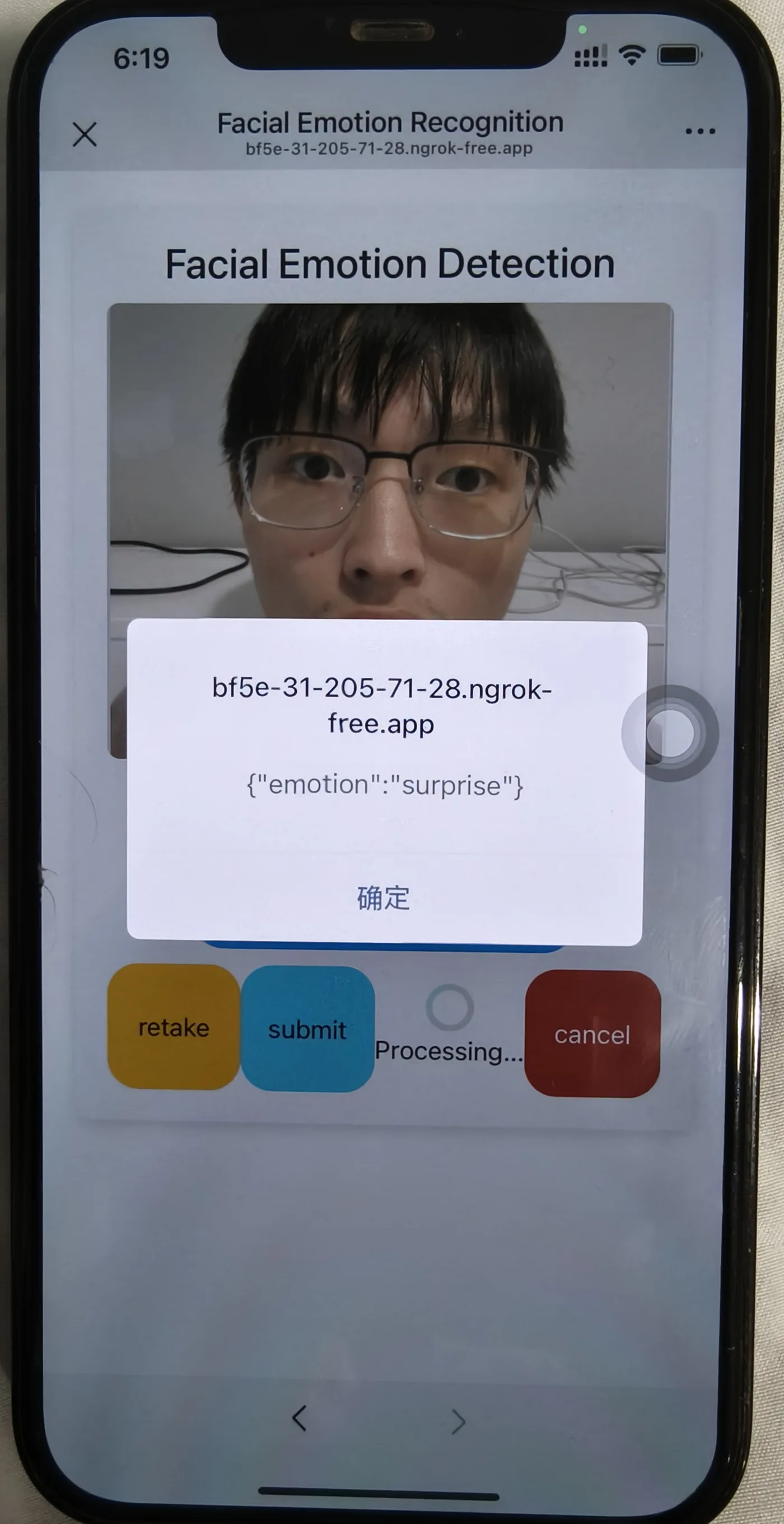
Design a practical system in which a user submits a facial image, the application validates and preprocesses it, a trained model estimates an expression category, and the result is returned through a clear interface.
I carried out the literature review, requirements analysis, system architecture, front-end and server-side implementation, model integration, testing, results analysis, privacy considerations and final technical report.
The supplied report describes a Java/Tomcat web application connected to a Python/PyTorch pipeline using a pretrained Swin Transformer. It discusses FER2013, RAF-DB and synthetic augmentation sources.
The final report states an overall accuracy of 76.25%. This is presented as a report-derived result and was not independently reproduced during this website build.
The strongest evidence is the completed end-to-end workflow and the explicit analysis of testing and limitations, not a claim that facial expression equals a person’s internal emotional state.
Functional requirements, non-functional requirements, architecture, error handling, responsive UI, model testing, confusion matrices and class-level discussion.
Public datasets can differ in lighting, pose, demographics, annotation conventions and collection environment. These differences limit direct comparison and real-world generalisation.
Future work should prioritise subject-separated splits, calibration, repeated runs, ablation studies, external testing and explicit comparison of synthetic augmentation against real held-out data.
The system is an academic demonstration, not a diagnostic, psychological or surveillance tool. Image consent, retention, bias and uncertainty require explicit controls in any real deployment.